
Career entrants
Applicants with no industry experience who want a structured, credentialed route into a profession that offers real progression across New Zealand, Australia and the Pacific.
Study pathway
A complete professional pathway into table games dealing, built on documented procedure, supervised practical hours and NZQA-aligned certification.
The Dealer Academy is the largest of Solvarienne's five programmes and the entry point for most of our graduates. It is designed for people with no previous exposure to a licensed gaming floor as well as for working staff seeking formal certification of skills learned informally on the job.
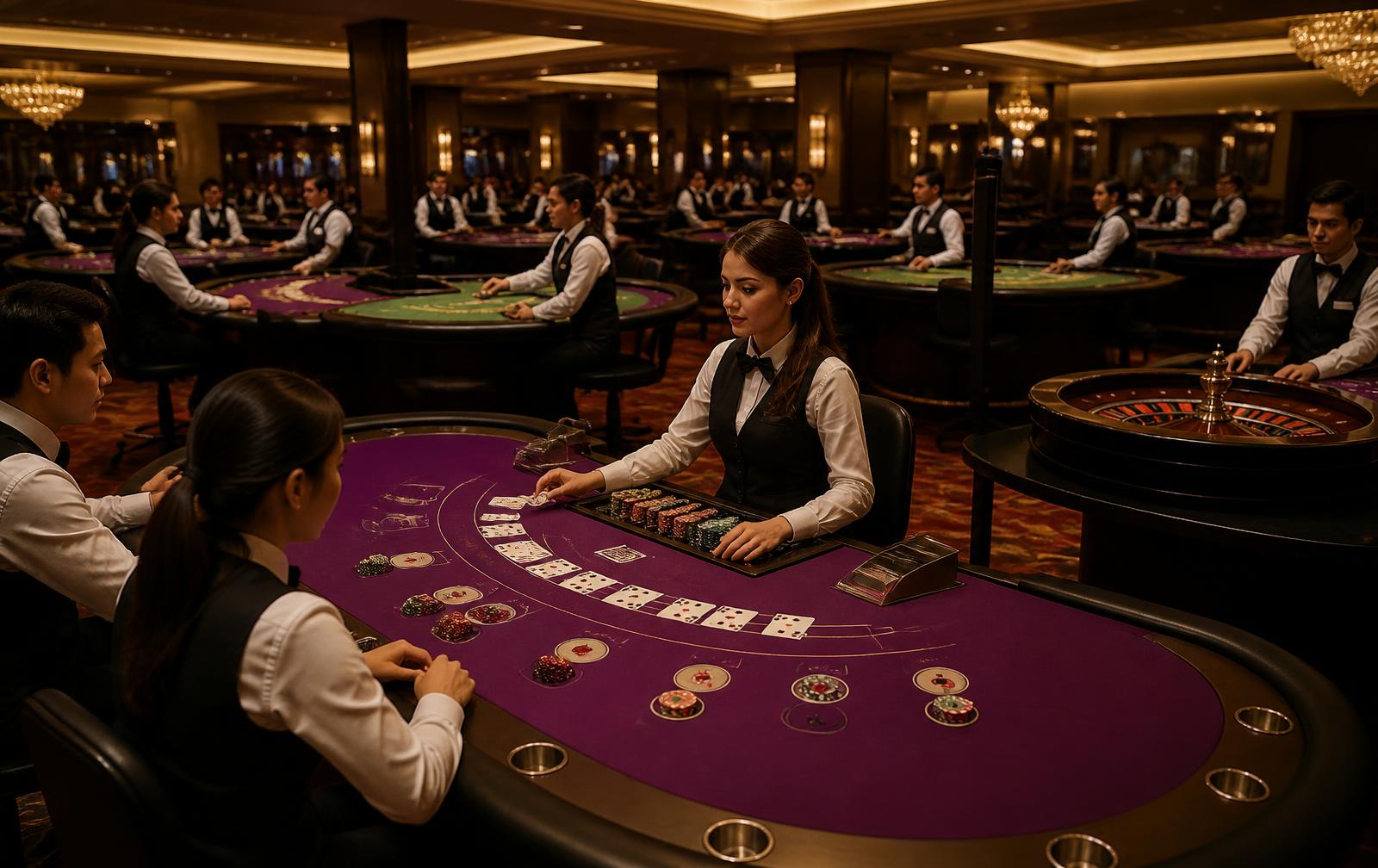
Teaching is organised around the four principal table disciplines — Blackjack, Roulette, Baccarat and Poker — followed by live table formats and multi-game rotation, taught from Auckland and reinforced through practicum weeks at our Queenstown hospitality studio. Each discipline is taught to a written procedural standard drawn from partner operator manuals, then practised until accuracy, pace and communication reach published benchmarks under the Solvarienne Practice Framework.
Because the profession is judged on consistency rather than occasional brilliance, the practical phases are deliberately repetitive. Learners deal thousands of hands and hundreds of spins under observation. Errors are corrected the moment they appear, so graduates arrive at their first floor audition with technique that holds under pressure rather than technique that only works when nobody is watching.
The academic side is equally rigorous. Learners study game protection, dispute procedure, Host Responsibility obligations, AML/CFT awareness, cash and chip control and the professional conduct expected of DIA-licensed staff. These are examined formally, because a technically excellent dealer who mishandles an incident is a liability to the employer who hired them.
Deal all four principal table disciplines to published procedural standards with an accuracy rate above 99.4% across a full assessed shift.
Reach professional pace benchmarks in each discipline without loss of accuracy, procedure compliance or guest communication quality.
Apply game protection principles, recognise irregularities and escalate them through the correct chain of authority without disrupting play.
Handle chips, cash equivalents and table inventory to auditable control standards, including opening, closing and mid-shift verification.
Objectives are written as observable behaviours, not aspirations. Each one is assessed against a published rubric before certification is issued.
Deal all four principal table disciplines to published procedural standards with an accuracy rate above 99.4% across a full assessed shift.
Reach professional pace benchmarks in each discipline without loss of accuracy, procedure compliance or guest communication quality.
Apply game protection principles, recognise irregularities and escalate them through the correct chain of authority without disrupting play.
Handle chips, cash equivalents and table inventory to auditable control standards, including opening, closing and mid-shift verification.
Communicate clearly and manaakitanga-led with guests of any background, resolving routine questions without supervisor involvement.
Demonstrate the conduct, presentation and DIA regulatory awareness required of licensed personnel in a controlled operating environment.
Admissions interviews place every applicant into one of these groups, and the entry module is adjusted accordingly. Nobody repeats material they already command, and nobody is pushed past a standard they have not yet reached.
Applicants with no industry experience who want a structured, credentialed route into a profession that offers real progression across New Zealand, Australia and the Pacific.
Bar, restaurant and front-of-house staff transferring into gaming operations, who already hold service instincts and need technical certification.
Staff trained informally in-house who need a portable, NZQA-aligned credential to move between employers or property tiers.
Groups sponsored by a partner employer preparing to open a new venue or expand a floor, trained together to a single house standard.
Every module carries documented contact hours, a written standard and its own assessment gate. Modules must be passed in sequence.
Legal working age in New Zealand and eligibility for a gaming industry work authority where required.
Working English proficiency sufficient for guest communication; additional languages are an advantage for Pacific and Asian placements.
Sound numeracy — applicants complete a mental arithmetic screening covering multiplication, addition chains and percentage payouts.
Manual dexterity sufficient to develop chip and card handling technique, assessed during the diagnostic entry review.
A clean regulatory record and willingness to undergo the background checks required by DIA-licensed employers.
Availability for the full published timetable, including evening simulation blocks in the final phase.
Assessment is continuous and weighted. A single strong day cannot compensate for an unstable standard across the programme.
Kaiako score technique, accuracy, pace and procedure compliance in every practical session, producing a rolling competency record rather than a single snapshot.
Ten closed-book papers covering procedure, mathematics, regulation and conduct. A minimum of 78% is required to progress from each module.
A four-hour multi-table rotation under live operating conditions, assessing endurance, consistency, guest interaction and incident handling.
A two-hour practical examination graded by an external examiner drawn from the partner employer panel, plus a professional conduct interview.
Every certificate carries a unique registry number, verifiable by any employer through the Solvarienne graduate registry for the lifetime of the credential.
Numbered Certified Table Games Dealer certificate issued by the Solvarienne Academic Board, aligned to the NZQA framework.
Verifiable digital credential recorded in the public Solvarienne graduate registry, including discipline specialisations.
Assessed practical hours portfolio detailing supervised time in each discipline.
Transcript of module scores and competency profile for submission to prospective employers.
Recognition by 210 partner employers across New Zealand, Australia and the Pacific, including agreed hiring pathways at 58 venues.
Optional annual re-certification clinic to keep the credential current for senior roles and cross-border transfers.
Salary bands reflect New Zealand full-time equivalents reported by partner employers over the last twelve months.
| Role | Indicative band | Detail |
|---|---|---|
| Table Games Dealer | NZ$52,000 – NZ$62,000 | The standard entry role. Graduates typically begin on two disciplines and add specialisations within the first year of employment. |
| Live Studio Dealer | NZ$55,000 – NZ$68,000 | Broadcast environments favour presentation skills and scripted delivery, and often offer more predictable scheduling than floor work. |
| Premium Table Dealer | NZ$62,000 – NZ$80,000 | High-value tables require faultless accuracy, discretion and advanced baccarat protocol. Usually reached after eighteen to thirty months. |
| Dealer Trainer / Inspector | NZ$68,000 – NZ$88,000 | The first supervisory step: monitoring multiple tables, correcting technique and supporting new staff through their probationary period. |
| Pit Supervisor | NZ$74,000 – NZ$95,000 | Accountability for a bank of tables across a shift, including compliance checks and first-line incident command. |
Director of Table Games Education
Hana spent nineteen years in Australasian table operations, including seven as head of dealer development for a multi-venue operator working across three states. She joined Solvarienne to build a curriculum that could produce consistent capability at scale, and she still teaches the roulette and game protection modules personally at the Auckland campus.
Enrolled learners can book supervised practice tables outside timetabled hours at no additional cost, seven days a week during term.
Chips, shoes, layouts, wheels and professional attire for assessment days are provided by the institute. There is no separate equipment charge.
Procedure manuals, technique video libraries and mathematics drills remain available for twenty-four months after graduation.
CV preparation, audition coaching, interview practice and direct introductions to partner employers recruiting in your preferred region.
Optional professional English sessions for guest communication, focused on the vocabulary and register used on an operating floor.
Graduates may attend one refresher clinic each year at any Solvarienne campus for the duration of their career, free of charge.
Across our Auckland, Wellington and Queenstown campuses.
For full-time graduates engaging with the careers office.
Recorded individually in each learner's portfolio.
From 2,910 post-programme surveys in 2025.
Request the programme prospectus and speak with an admissions adviser about Intake 12, formats and financing options.
A ninety-minute session covering numeracy, communication and dexterity, used to confirm the right entry route and support needs.
Identity, right-to-work and DIA eligibility documents are verified by the registrar before a place is confirmed.
A formal offer is issued with the timetable, fee schedule and instalment plan. A place is held for seven days on acceptance.
Campus orientation, equipment issue, dashboard setup and the first foundation sessions with your assigned cohort kaiako.
Mereana Walker enrolled straight from part-time hospitality work with no prior exposure to a gaming floor. She used the open practice tables most evenings, moved through the numeracy support track in the first month, and by the full-shift simulation was running Blackjack and Roulette to benchmark pace without a single procedure flag. She was offered a role at a partner venue in Auckland two weeks before graduation and was promoted to a premium table rotation within fourteen months.
Mereana Walker · Table Games Dealer, Auckland
I walked in with zero experience and walked out running a full pit rotation on my first rostered shift. The repetition is the whole point.
The game protection module changed how I watch a table. I caught an irregularity in my second week on the floor because of exactly what we drilled.
Coming from hospitality, I was worried about the mathematics. The numeracy support track got me there without anyone making me feel behind.
Still unsure? The admissions team answers written enquiries within two working days.
A shorter, craft-intensive route into professional handling technique.
View pathwayThe next step for graduates ready to move into supervision and leadership.
View pathwaySharpen guest communication skills alongside your technical certification.
View pathwayNext intake · 6 October
Cohorts are capped so that every learner receives supervised table time. Applications are assessed in the order they arrive.