Fast-track entrants
Applicants who want the shortest credible professional route into the profession and are prepared for an intensive, workshop-heavy schedule.
Study pathway
Craft-first preparation for the croupier profession, where handling technique, rhythm, control and table presence are trained until they are automatic.
Where the Dealer Academy is broad, the Croupier School is deep. It concentrates on the manual craft that separates a competent croupier from an impressive one: how chips are cut and sized, how cards move, how a table is controlled, and how a professional maintains rhythm and courtesy for six hours without visible effort.
The programme suits applicants who want to enter the profession quickly with exceptional handling technique, and employers who need staff able to hold a busy table on a Saturday night without supervisory support. It is also the route chosen by many learners who intend to add discipline specialisations later through the Dealer Academy.
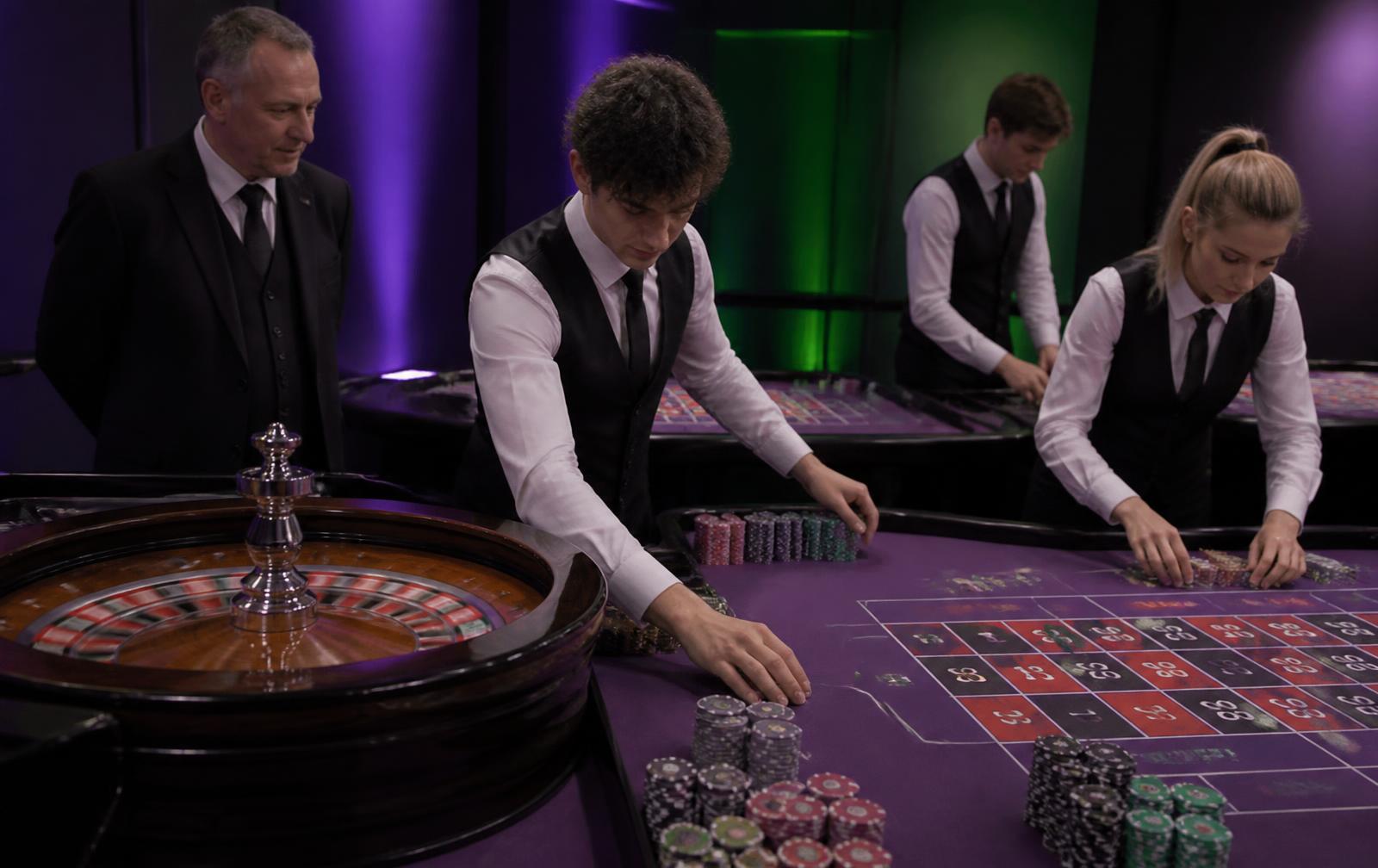
Training is organised as a workshop rather than a lecture series, delivered from our Wellington teaching floor with practicum blocks in Auckland. Learners spend the overwhelming majority of contact hours at a table, working through graded technical exercises with a kaiako at their shoulder. Speed is introduced only once accuracy is established, because a fast croupier with unstable technique is a liability.
Alongside the craft, learners study table etiquette, operational standards, customer interaction and the professional presentation expected in premium environments. The final fortnight is given entirely to workshop simulation and certification assessment under observation.
Perform all core chip operations — cutting, sizing, stacking, colour changes and payout construction — accurately at professional speed.
Handle cards to procedural standard with controlled, protected and consistent movement across all taught formats.
Maintain table control, rhythm and bet discipline through busy periods without loss of accuracy or courtesy.
Meet published speed benchmarks in each assessed exercise while sustaining a compliance rate above 99%.

Objectives are written as observable behaviours, not aspirations. Each one is assessed against a published rubric before certification is issued.
Perform all core chip operations — cutting, sizing, stacking, colour changes and payout construction — accurately at professional speed.
Handle cards to procedural standard with controlled, protected and consistent movement across all taught formats.
Maintain table control, rhythm and bet discipline through busy periods without loss of accuracy or courtesy.
Meet published speed benchmarks in each assessed exercise while sustaining a compliance rate above 99%.
Apply table etiquette and operational standards consistently, including announcements, guest address and dispute avoidance.
Sustain professional presence, posture and composure across a full assessed shift under observation.
Admissions interviews place every applicant into one of these groups, and the entry module is adjusted accordingly. Nobody repeats material they already command, and nobody is pushed past a standard they have not yet reached.
Applicants who want the shortest credible professional route into the profession and are prepared for an intensive, workshop-heavy schedule.
Working staff whose procedural knowledge is sound but whose handling technique limits their progression to busier or premium tables.
Groups hired ahead of a floor expansion who must reach a uniform handling standard before opening night.
Hospitality professionals in Queenstown and other visitor destinations who need certified craft skills alongside their existing guest-facing experience.
Every module carries documented contact hours, a written standard and its own assessment gate. Modules must be passed in sequence.
Legal working age in New Zealand and eligibility for the relevant gaming work authority.
Manual dexterity and fine motor control, assessed practically during the diagnostic entry review.
Working English proficiency for announcements, guest address and assessment instructions.
Functional numeracy sufficient for payout construction; supported numeracy sessions are available if required.
Physical capacity to stand and work at a table for extended assessed periods.
Commitment to the intensive workshop schedule, which averages thirty contact hours per week.
Assessment is continuous and weighted. A single strong day cannot compensate for an unstable standard across the programme.
Sixty graded handling exercises scored for accuracy and speed, forming a continuous record of craft development from week one to week thirteen.
Timed assessments at weeks four, eight and eleven. Accuracy must be maintained above 99% for a benchmark result to be recorded.
Scenario-based assessment of guest address, discretion, dispute avoidance and composure under provocation, scored by two observers.
A three-hour observed workshop shift graded by an external examiner, covering craft, control, procedure and professional presence.
Every certificate carries a unique registry number, verifiable by any employer through the Solvarienne graduate registry for the lifetime of the credential.
Numbered Certified Croupier certificate issued by the Solvarienne Academic Board, NZQA-aligned.
Verifiable digital credential listing benchmark speeds and accuracy rates achieved at final assessment.
Workshop portfolio documenting all 360 supervised hours and the progression across graded exercises.
Direct credit toward Dealer Academy discipline specialisations without repeating shared modules.
Recognition by 210 partner employers, with 36 venues offering direct audition pathways to Croupier School graduates.
Eligibility for the annual craft refresher clinic held at every campus.
Salary bands reflect New Zealand full-time equivalents reported by partner employers over the last twelve months.
| Role | Indicative band | Detail |
|---|---|---|
| Croupier | NZ$50,000 – NZ$60,000 | The core role, working the principal table formats on a rotating floor schedule with progression based on technique and reliability. |
| Premium Room Croupier | NZ$60,000 – NZ$76,000 | Higher-value tables where discretion, faultless craft and guest familiarity matter more than volume throughput. |
| Resort and Tourism Croupier | NZ$52,000 – NZ$66,000 | Roles in Queenstown and other visitor destinations combining table work with a broader hospitality remit. |
| Technique Coach | NZ$64,000 – NZ$82,000 | In-house craft coaching for employers running their own induction programmes, often combined with inspector duties. |
| Pit Inspector | NZ$68,000 – NZ$86,000 | First-line oversight of table craft and compliance across a bank of tables during a shift. |
Lead Assessor, Croupier School
Marama has completed more than five thousand supervised practical assessments across Solvarienne's three campuses and designed the graded exercise system on which the Croupier School is built. She spent twelve years on Australasian floors before moving into education, and remains convinced that the single greatest predictor of a long career is technique established correctly in the first fortnight.
No practical session exceeds four learners per kaiako, so technique correction is immediate rather than occasional.
Every graded exercise result is recorded and charted, letting learners see precisely which movements are limiting their benchmark speed.
Practical rooms are available for supervised independent practice outside timetabled hours throughout the programme.
Each learner receives a personal practice chip set and card decks to continue technique drills between sessions.
Two dedicated audition rehearsal sessions modelled on the recruitment processes of our partner employers.
Certified croupiers receive module exemptions when they later enrol on Dealer Academy specialisations or supervisory certification.
Across all campuses running the workshop format.
Measured for graduates using the careers office.
Each scored for both accuracy and speed.
Average final assessment accuracy across 2025 cohorts.
A short practical screening establishes your starting point and identifies whether a preparatory week would benefit you.
A conversation with a faculty member about schedule commitment, career intentions and the intensity of the workshop format.
Identity, eligibility and right-to-work documents are verified by the registrar before the offer is issued.
Acceptance of the offer, selection of an instalment plan where required, and allocation to a named workshop group.
Practice kit issue, dashboard setup and the first graded exercises with your workshop kaiako in week one.
Ana Fetu came to the Croupier School straight from part-time café work in Queenstown, drawn by the shorter timetable and lower upfront cost. She used the open practice tables almost every evening and finished top of her cohort's benchmark speed tests. Within ten months of certifying she moved from a standard floor rotation into the premium room, where her instructors say her etiquette scores were the strongest they had recorded that year.
Ana Fetu · Croupier, Queenstown
The one-to-four ratio meant every bad habit got fixed before it became permanent. I've never seen anyone learn chip handling this fast.
I came in with shaky hands and no confidence. By week eight I was cutting stacks faster than staff who'd been dealing for years.
The etiquette module is underrated. It's the difference between being tolerated at a table and being requested by name.
Still unsure? The admissions team answers written enquiries within two working days.
Add full discipline certification and regulatory theory on top of your craft foundation.
View pathwayMove from table craft into floor supervision and leadership.
View pathwayBuild the guest interaction skills that turn craft into a premium table reputation.
View pathwayNext intake · 6 October
Cohorts are capped so that every learner receives supervised table time. Applications are assessed in the order they arrive.